
Acoustic Performance Metrics Procurement Teams Need
- Acoustic Performance Metrics Procurement Teams Need for a Music Recording Booth
- Why Acoustic Metrics Matter for a Music Recording Booth
- Primary Metric: Sound Transmission Class (STC) for a Music Recording Booth
- Key Metric: Noise Reduction Coefficient (NRC) for a Music Recording Booth
- Critical Metric: Reverberation Time (RT60) for a Music Recording Booth
- Practical Metric: Sound Pressure Level (SPL) Reduction for a Music Recording Booth
- Speech and Music Clarity Metrics (C50, C80, and STI) for a Music Recording Booth
- How Metrics Should Be Measured and Reported for a Music Recording Booth
- On-Site Validation and Real-World Testing for a Music Recording Booth
- Comparing Options: Example Metrics Table for a Music Recording Booth
- Procurement Checklist: What to Require When Buying a Music Recording Booth
- Integration Considerations for a Music Recording Booth (Ventilation, Lighting, Power)
- Cost vs Performance: Total Cost of Ownership for a Music Recording Booth
- Vendor Assessment: Questions to Ask About a Music Recording Booth
- Why Silence Booth/Office pod Prefabricated V series - M size Fits Music Recording Booth Procurement Needs
- Brand Advantages Summary for Silence Booth as a Music Recording Booth Supplier
- FAQ — Frequently Asked Questions About Acoustic Metrics for a Music Recording Booth
- Contact & View Product CTA
- Authoritative References and Further Reading
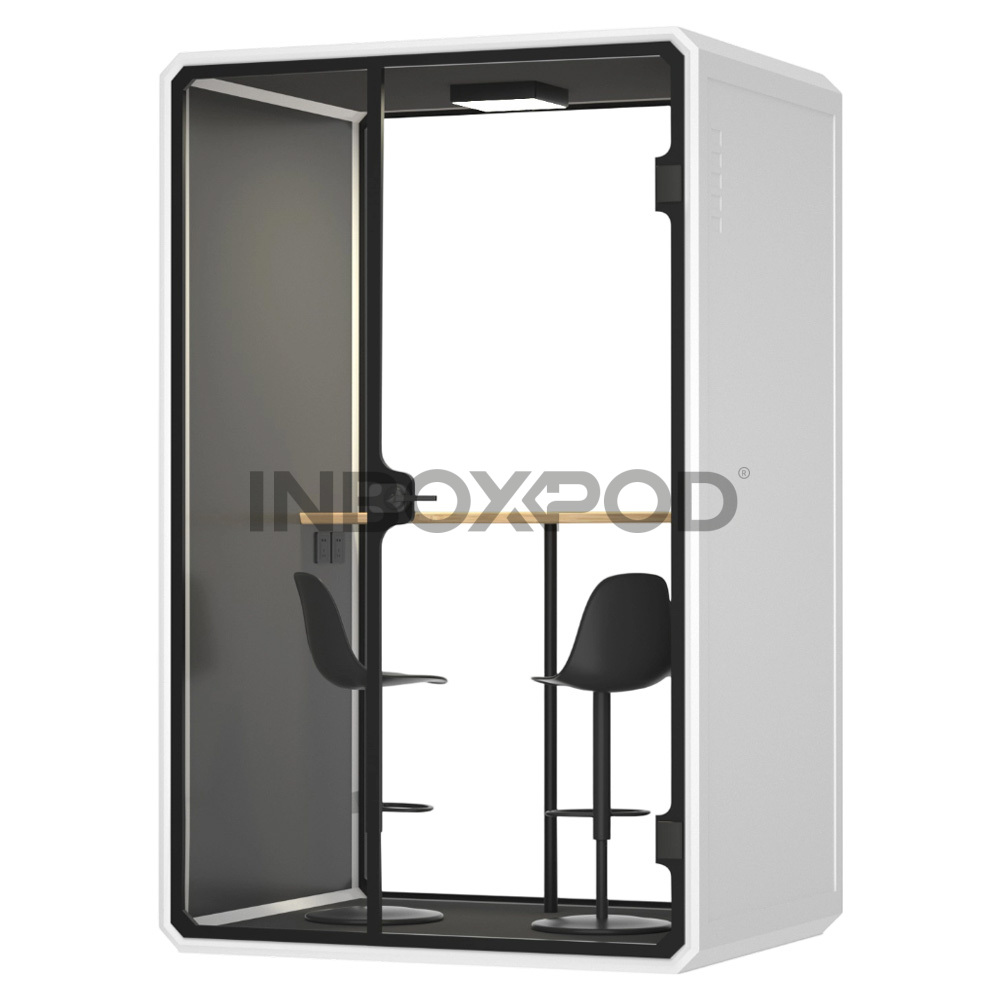
Acoustic Performance Metrics Procurement Teams Need for a Music Recording Booth
When procurement teams evaluate a music recording booth, they need more than glossy specs and sales claims — they need measurable acoustic performance metrics that predict how the booth will perform in real-world recording and collaboration scenarios. This guide explains the primary metrics you should require, how they're measured, what acceptable ranges look like for professional use, and how to validate vendor claims using the Silence Booth/Office pod Prefabricated V series - M size as a practical example.
Why Acoustic Metrics Matter for a Music Recording Booth
Procurement decisions influence recording quality, client satisfaction, and total cost of ownership. For music recording booths, acoustic metrics determine how much external noise is isolated, how reflections inside the booth affect recordings, and whether the booth supports both speech and music capture without unwanted coloration. Choosing a product without quantifiable metrics risks purchasing a solution that underperforms in your actual environment — leading to rework, additional acoustic treatment costs, or compromised recording sessions.
Primary Metric: Sound Transmission Class (STC) for a Music Recording Booth
Sound Transmission Class (STC) rates how much airborne sound is reduced by a partition. For procurement teams specifying a music recording booth, STC is critical because it indicates how well external noise (street noise, HVAC, adjacent rooms) is kept out.
- What STC measures: Average attenuation across mid to high frequencies (125–4000 Hz).
- Useful range for music recording booths: STC 30–40 may be acceptable for speech and podcast booths; STC 40+ is recommended for professional music recording or critical listening tasks.
- How vendors should present it: Reported STC must be based on ASTM E413 or ISO 717-1 lab testing.
Key Metric: Noise Reduction Coefficient (NRC) for a Music Recording Booth
NRC quantifies the average absorption of sound within a booth — how much sound energy is absorbed versus reflected. For a music recording booth, internal reflections matter: excessive reflections cause comb-filtering and unwanted reverb; too much absorption can deaden sound.
- What NRC measures: Average absorption between 250–2000 Hz (scale 0.0–1.0).
- Recommended NRC: 0.5–0.9 depending on use — higher for voice-over and podcast booths, moderate for music booths to preserve natural tonal balance.
- Procurement tip: Request frequency-dependent absorption curves, not only a single NRC value.
Critical Metric: Reverberation Time (RT60) for a Music Recording Booth
RT60 is the time it takes for sound to decay by 60 dB. Short RT60 helps with dry, close-miced recordings; slightly longer RT60 can provide musical warmth. Procurement teams must specify RT60 targets by frequency bands to match intended use.
- What RT60 measures: Decay time across octave or third-octave bands (125 Hz–4 kHz commonly).
- Recommended RT60: For a small music recording booth (M-size), aim for RT60 < 0.3s at mid/high frequencies and slightly longer (0.3–0.5s) at low frequencies if some room tone is desired.
- Procurement tip: Vendors should supply RT60 plots measured per ISO 3382 or equivalent methodology.
Practical Metric: Sound Pressure Level (SPL) Reduction for a Music Recording Booth
SPL reduction (dB) at specific frequencies or as averaged A-weighted reductions indicates how much quieter the inside of the booth will be relative to the outside. For music recording booths, low-frequency isolation matters most because bass energy penetrates irregularly constructed partitions.
- What SPL reduction measures: dB attenuation at selected frequencies and broadband A-weighted reduction (dBA).
- Useful benchmarks: 20–35 dB(A) reduction across the spectrum is often needed for reliable music recording in noisy environments; specialized isolation can exceed 40 dB at mid/high frequencies but low-frequency performance is harder to achieve.
Speech and Music Clarity Metrics (C50, C80, and STI) for a Music Recording Booth
Metrics such as C50 (clarity for speech), C80 (clarity for music), and Speech Transmission Index (STI) provide functional insight into how a booth will support intelligibility and musical fidelity.
- C50: Positive values (>0 dB) indicate good speech clarity for speech-focused booths.
- C80: Higher values correlate with better perceived musical clarity and presence.
- STI: Ranges from 0 (bad) to 1 (excellent); aim for >0.6 for clear speech tasks in a music recording booth setting.
How Metrics Should Be Measured and Reported for a Music Recording Booth
Procurement teams should insist that all metrics be measured using recognized standards. Accept only lab or on-site tests with full frequency plots and test reports signed by accredited labs.
- Standards to require: ASTM E90 / ASTM E413 for STC, ISO 11654 for absorption/NRC, ISO 3382 for RT60, IEC 60268-16 for STI.
- Reports should include: Test setup diagrams, microphone and source positions, room conditions, equipment calibration, and raw frequency band data.
- Validation: If the vendor provides only single-number claims (e.g., STC 35), request the full test report or independent third-party validation.
On-Site Validation and Real-World Testing for a Music Recording Booth
Lab data is essential, but on-site validation ensures the installed booth performs within your specific environment. Procurement teams should plan for a two-step acceptance process: factory/third-party lab testing followed by on-site verification after installation.
- On-site tests to run: Broadband SPL reduction measurements, RT60 checks across bands, transient response checks with test signals (impulse/sweeps), and subjective session tests with engineers or musicians.
- Acceptance criteria: Pre-agreed tolerances from lab numbers (e.g., within ±2–3 dB across critical bands) and functional sign-off by an audio professional.
Comparing Options: Example Metrics Table for a Music Recording Booth
Below is a comparative example showing how procurement teams can present normalized metrics to compare vendors. Values are illustrative; require vendor test reports for real procurement.
| Metric | Typical Basic Booth | Silence Booth/Office pod Prefabricated V series - M size | High-End Studio Booth |
|---|---|---|---|
| STC (lab) | 28–32 | 38–42 (vendor reported — request lab report) | 45+ |
| NRC | 0.4–0.6 | 0.6–0.8 (balanced panels) | 0.7–0.9 |
| RT60 (500–2000 Hz) | 0.4–0.8s | 0.2–0.4s (designed for speech & focused work) | 0.15–0.3s |
| SPL Reduction (A-weighted) | 15–25 dBA | 25–35 dBA (typical range) | 35–45 dBA+ |
| STI / C50 / C80 | 0.45–0.6 / -1 to 0 dB / 0–2 dB | 0.6–0.75 / 0–2 dB / 2–4 dB | >0.75 / >2 dB / >4 dB |
Procurement Checklist: What to Require When Buying a Music Recording Booth
Use this checklist to make rigorous procurement decisions:
- Full lab test reports (ASTM/ISO referenced) for STC, NRC, RT60, and SPL reduction.
- On-site validation plan and acceptance criteria.
- Detailed descriptions of ventilation, lighting, electrical, and cable management systems (these affect usability during recording).
- Warranty, service-level agreements, and installation scope.
- Third-party references or case studies from customers using the booth as a music recording booth.
- Options for additional acoustic upgrades (bass traps, diffusers, mic isolation) and modularity.
Integration Considerations for a Music Recording Booth (Ventilation, Lighting, Power)
Acoustic performance is not only about walls: ventilation noise, lighting hum, and cable pass-throughs can undermine studio-grade recordings. Procurement teams should verify:
- Ventilation noise levels in dBA at typical operating flow rates (spec target: <25–30 dBA inside when fans are running, depending on ambient requirements).
- Lighting flicker (<1% or LED drivers with high-frequency drivers) and absence of tonal noise from fans or transformers.
- Power provision, grounding, and EMI shielding if sensitive electronics will be used inside the music recording booth.
Cost vs Performance: Total Cost of Ownership for a Music Recording Booth
Procurement should consider installation, transport, acoustic accessories, and potential downtime. Sometimes a higher upfront investment in a better-isolating booth reduces long-term costs by avoiding additional room treatments and project interruptions.
- Evaluate initial price, installation labor, additional acoustic treatment, and maintenance costs.
- Consider resale value and modularity — booths that can be reconfigured or relocated often offer better lifecycle ROI.
Vendor Assessment: Questions to Ask About a Music Recording Booth
Key questions to include during vendor selection:
- Can you provide complete lab test reports for STC, NRC, RT60, and SPL reduction per recognized standards?
- What are typical on-site vs lab performance deviations, and do you provide in-field tuning?
- How is ventilation engineered to balance airflow and acoustic quietness?
- Do you offer acoustic customization (baffling, absorption/diffusion options) for music recording booth needs?
- What warranties and response times are included in the service agreement?
Why Silence Booth/Office pod Prefabricated V series - M size Fits Music Recording Booth Procurement Needs
Product overview: Silence Booth/Office pod Prefabricated V series - M size
Ideal for two-person discussions or focused solo work, the M-size booth offers a balanced mix of privacy and flexibility. Its advanced acoustic panels reduce external noise effectively, while the smart ventilation and lighting systems create a comfortable, quiet environment for calls, meetings, or concentrated tasks.
How this maps to procurement criteria for a music recording booth:
- Balanced acoustic panels — provide mid/high absorption while retaining some liveliness for musical capture.
- Engineered ventilation — designed to minimize fan noise while maintaining adequate airflow.
- Prefabricated modular design — simplifies installation, relocation, and future upgrades (TCO advantages).
- Recommended acceptance process: Request lab testing documentation for STC and RT60, and plan an on-site confirmation with your audio engineer.
Brand Advantages Summary for Silence Booth as a Music Recording Booth Supplier
When you evaluate brands, look for evidence of engineering rigor, transparency in testing, and support for installation and validation. Silence Booth's prefabricated V series emphasizes:
- Modularity and speed of deployment for organizations needing quick, reliable recording spaces.
- Balanced acoustic design that supports both spoken-word and light musical tasks without excessive deadening.
- Integrated systems (ventilation, lighting) built to minimize interference with recording quality.
- Commercial support for procurement teams: documentation packages, installation guides, and warranty terms to reduce procurement friction.
FAQ — Frequently Asked Questions About Acoustic Metrics for a Music Recording Booth
Q: Which single metric should I prioritize when buying a music recording booth?
A: There’s no single metric that tells the whole story. Prioritize STC for external isolation and RT60 plus absorption curves (NRC/frequency-dependent data) for internal acoustics. Combine these with SPL reduction measurements and STI/C50/C80 for functional clarity.
Q: Are lab STC numbers reliable for on-site performance?
A: Lab numbers are a controlled baseline and useful for comparison, but on-site performance can differ due to installation details, adjacent surfaces, and HVAC. Always require on-site verification as part of the acceptance criteria.
Q: My recordings suffer from low-frequency rumble. Which metric addresses that?
A: Low-frequency issues are best evaluated with octave-band SPL reduction and the STC low-frequency behavior (or more precisely, impact on dB reduction at 63 Hz and 125 Hz bands). Look for vendor data on low-frequency attenuation or request custom bass-trapping solutions.
Q: How quiet must ventilation be inside a music recording booth?
A: Aim for ventilation noise inside the booth under operating conditions to be below the noise floor needed for your recordings. For many music applications, internal ventilation noise <25–30 dBA is desirable; for very quiet classical or acoustic recordings, you may need quieter engineered solutions.
Q: Can the Silence Booth M-size be used for serious music tracking?
A: The M-size is optimized for two-person discussions and focused work; it can be suitable for small-scale or project-level music recording, voice-over, and podcasting. For critical multi-instrument tracking requiring ultra-low noise and superior low-frequency isolation, consider a larger studio or high-end isolation booth and ask the vendor for lab test reports specific to your use case.
Contact & View Product CTA
Ready to validate acoustic performance for your next music recording booth? Contact our sales and acoustic engineering team to request the Silence Booth/Office pod Prefabricated V series - M size technical dossier, lab test reports, and an on-site validation plan. Visit our product page or email sales@example.com to schedule a demo and acoustic walkthrough.
Interpreting acoustic metrics is most effective when paired with clear dimensional and structural specifications. For buyers evaluating space fit and capacity, refer to Specs Guide: Silence Booth Prefabricated V Series M Size.
Authoritative References and Further Reading
- ASTM International — Acoustic standards (ASTM E90, ASTM E413): https://www.astm.org
- International Organization for Standardization — ISO 3382 (Room Acoustics — Measurement of Reverberation Time): https://www.iso.org/standard/34435.
- ISO 11654 — Sound Absorbers (NRC/absorption measurement): https://www.iso.org/standard/12177.
- IEC 60268-16 — Sound System Equipment (Speech Transmission Index): https://www.iec.ch
- Wikipedia — Sound Transmission Class: https://en.wikipedia.org/wiki/Sound_transmission_class
Maintenance Tips for Long-Lasting Soundproof Booths
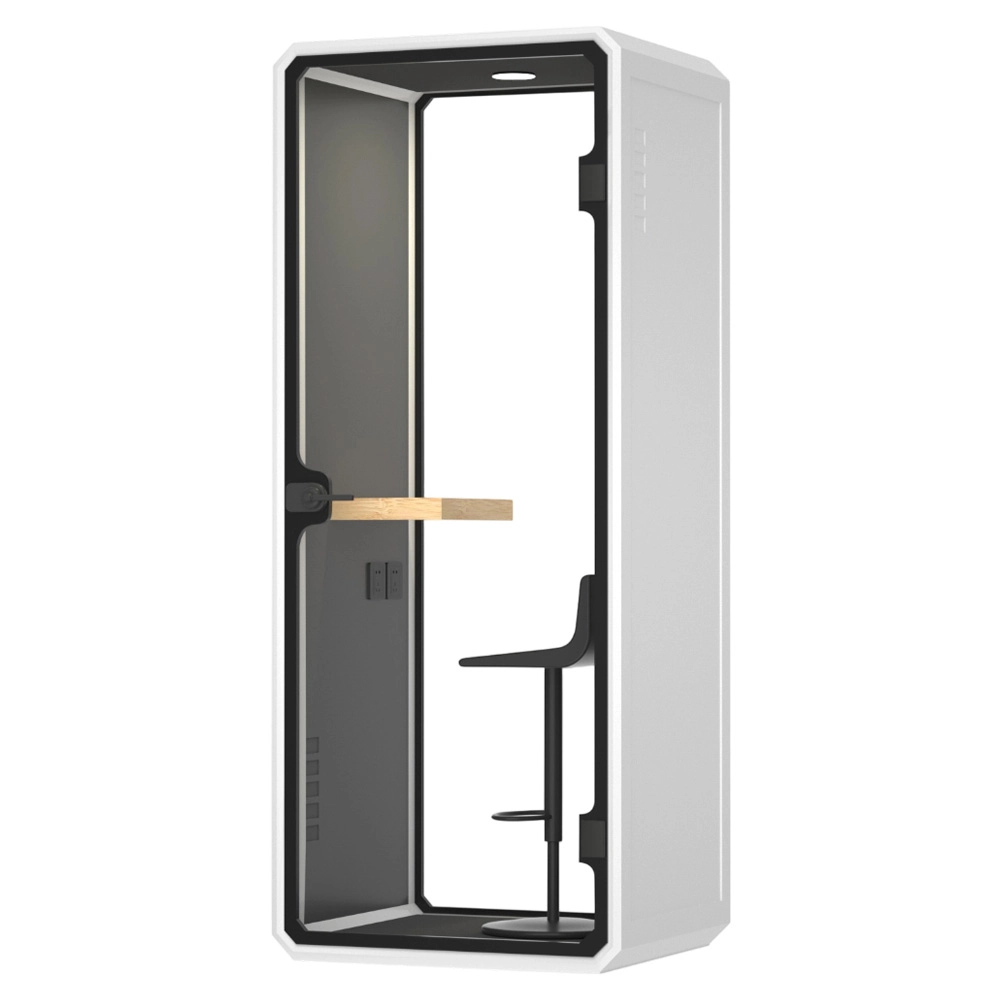
Prefab Silence Booth Office Pod V-S — High-Performance Soundproof Pods by INBOXpod
Buyer's Guide: Portable Soundproof Booths for Small Offices
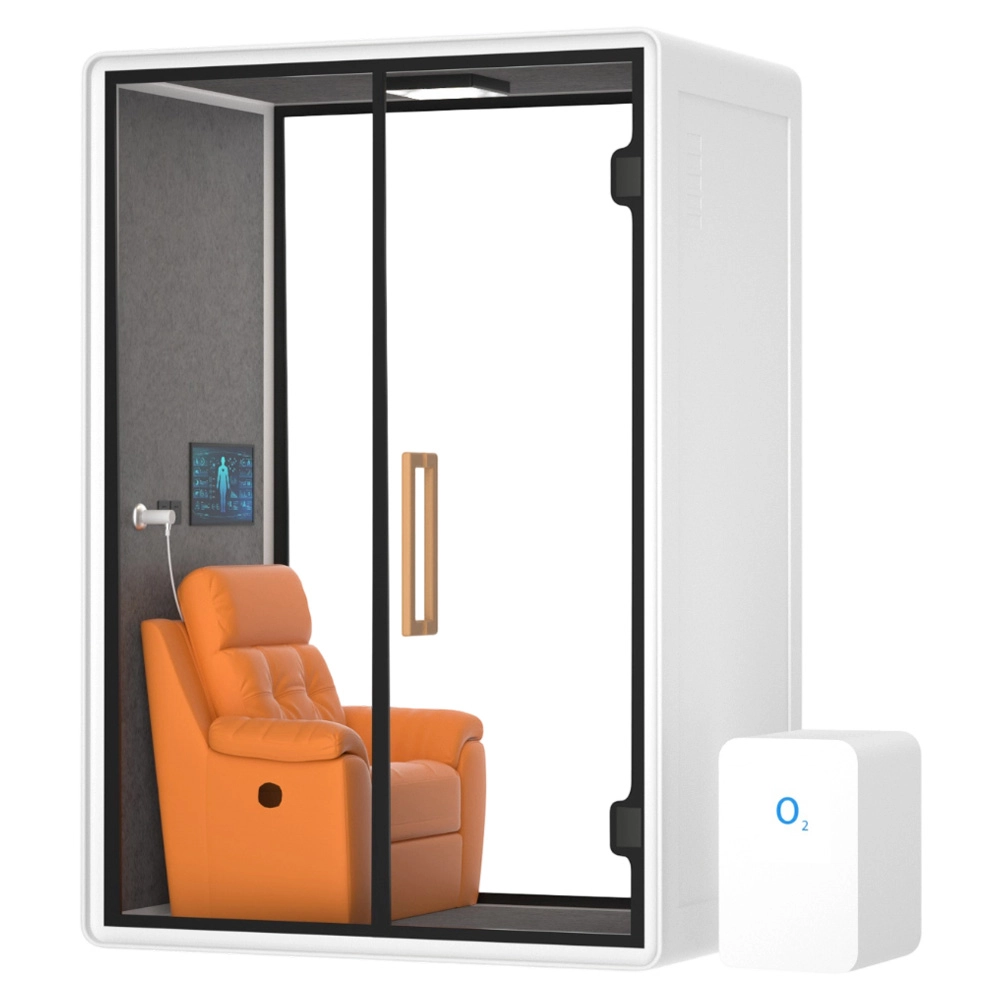
INBOXpod Soundproof Single-Seat Oxygen Pod — Private Focus, Clean Air, Superior Acoustics
Home-demo
Do you provide after-sales support and warranty?
Yes, we provide comprehensive after-sales service and warranty to ensure long-term satisfaction with our products.
Can the booths be customized to fit specific space requirements?
Yes, we offer flexible customization options including size, color, and additional features to perfectly suit your needs.
What materials are used in the construction of the booths?
Our booths are made from sustainable, high-quality materials including aluminum alloy frames and acoustic panels designed for optimal soundproofing.
How long does it take to assemble an INBOXpod booth?
Most of our booths can be assembled without tools in about 30 minutes, making installation quick and hassle-free.
What is the typical sound insulation level of your acoustic booths?
Our booths typically achieve up to 27 dB noise reduction, meeting Class B sound insulation standards suitable for offices and study environments.
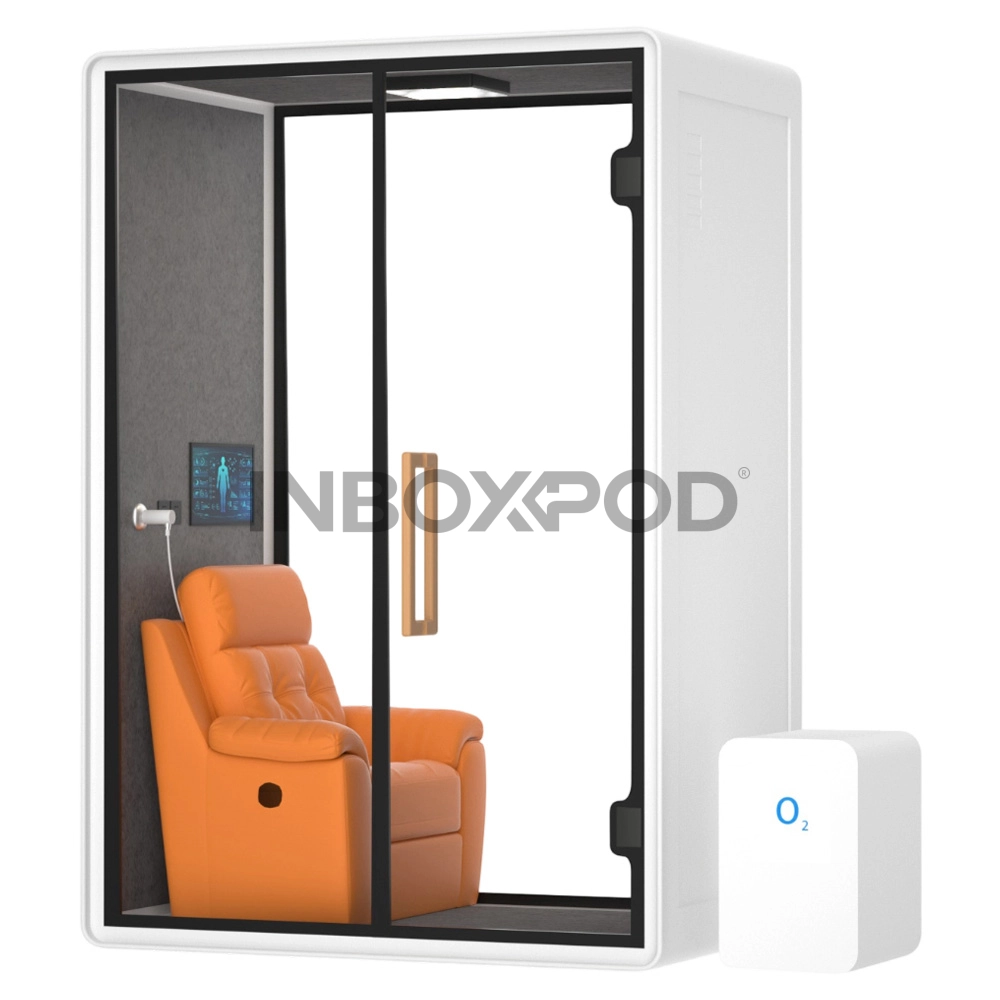
INBOXpod Soundproof Single seat Oxygen Pod
A delicate and compact personal oxygen therapy secret, with a single-seat layout that is flexible and convenient. External size: W1600×D1028×H2300 mm; internal size: W1466×D953×H2166 mm. Create a quiet, private domain for you, where you can inhale high-purity oxygen efficiently during daily relaxation or postoperative recovery, helping to improve cardiopulmonary function and mental state.
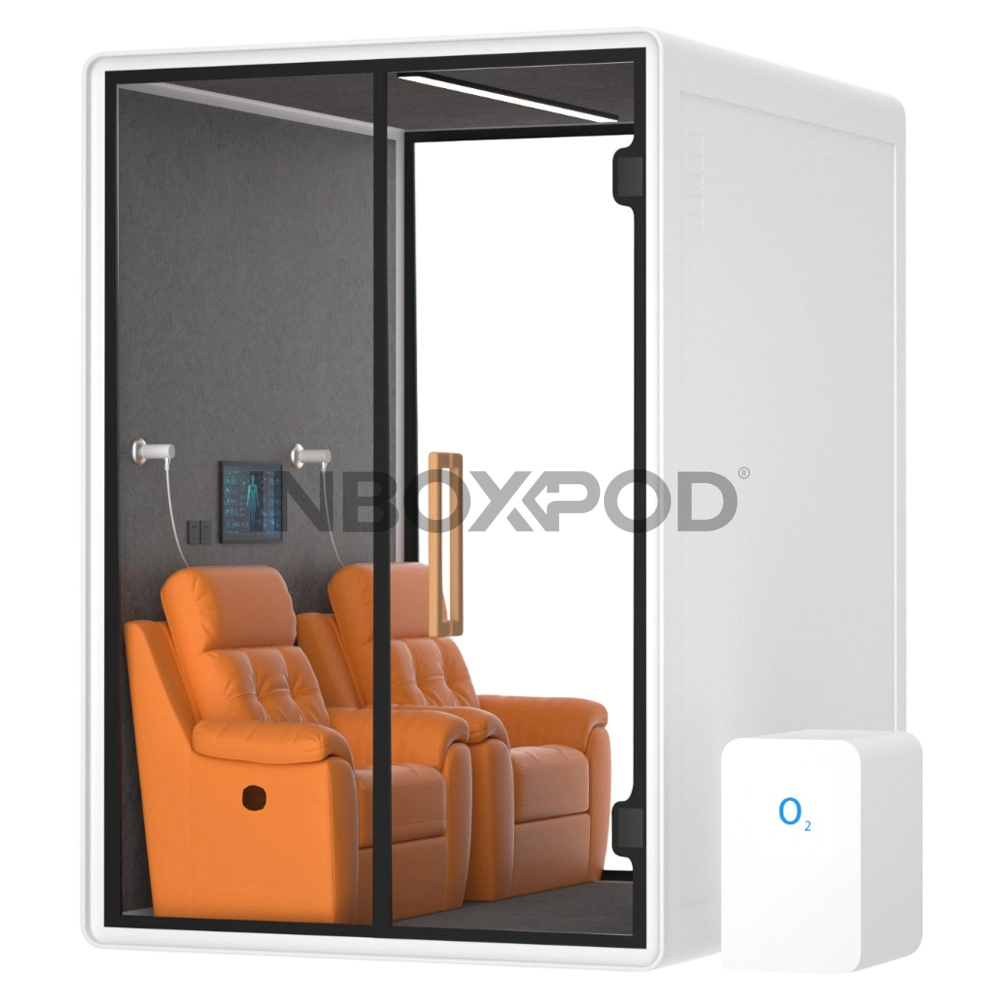
INBOXpod Double Seat Soundproof Oxygen Pod
An oxygen therapy space customized for double social interaction and health, with a double-seat design to promote a win-win situation for interaction and health. External size: W1600×D1929×H2300 mm; internal size: W1466×D1854×H2166 mm. You can improve cardiovascular function and concentration through oxygen therapy with friends and colleagues in a quiet and efficient acoustic environment, making health and social interaction complement each other.
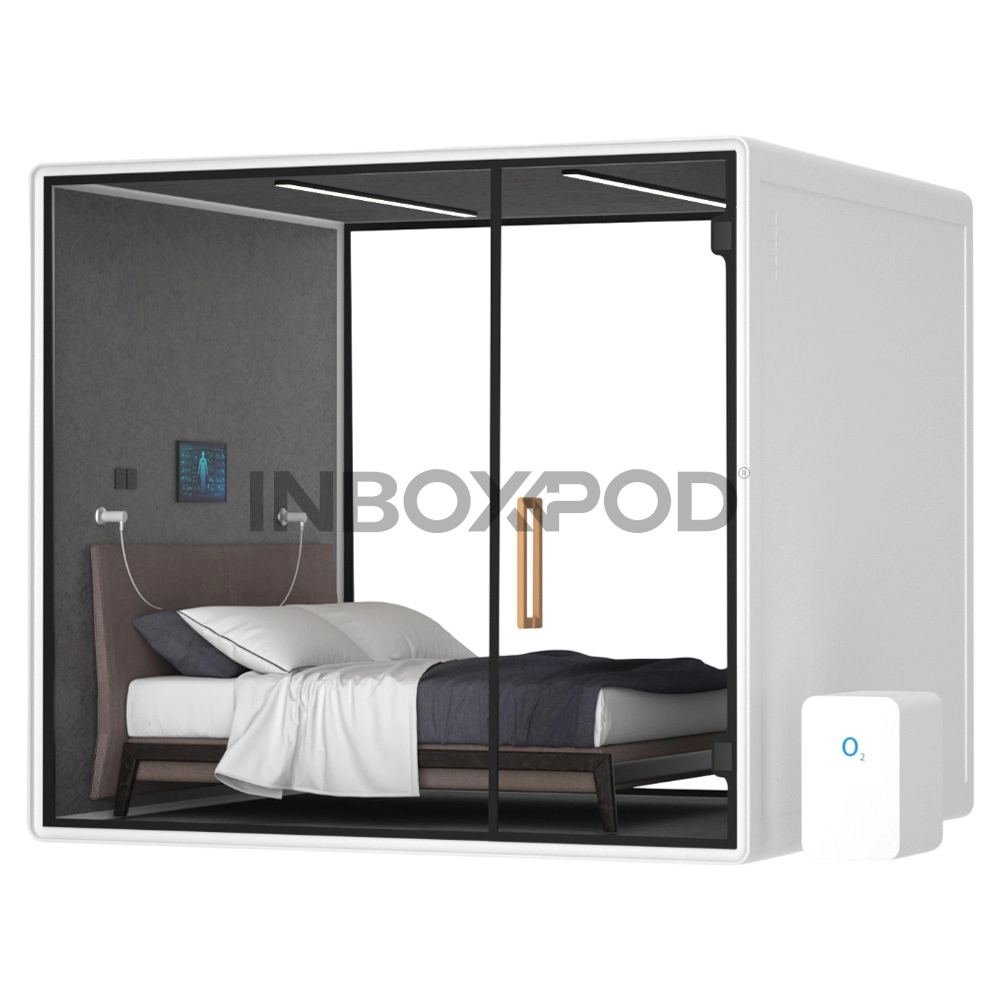
INBOXpod Soundproof Double Bed (small) Oxygen Pod
A double oxygen therapy option that balances space and experience, with a small double-bed layout suitable for various scenarios. External size: W2300×D1854×H2300 mm; internal size: W2300×D1929×H2300 mm. You can share the high-oxygen environment here with relatives and friends, relieve stress, improve physical fitness, and gain health and vitality in company.
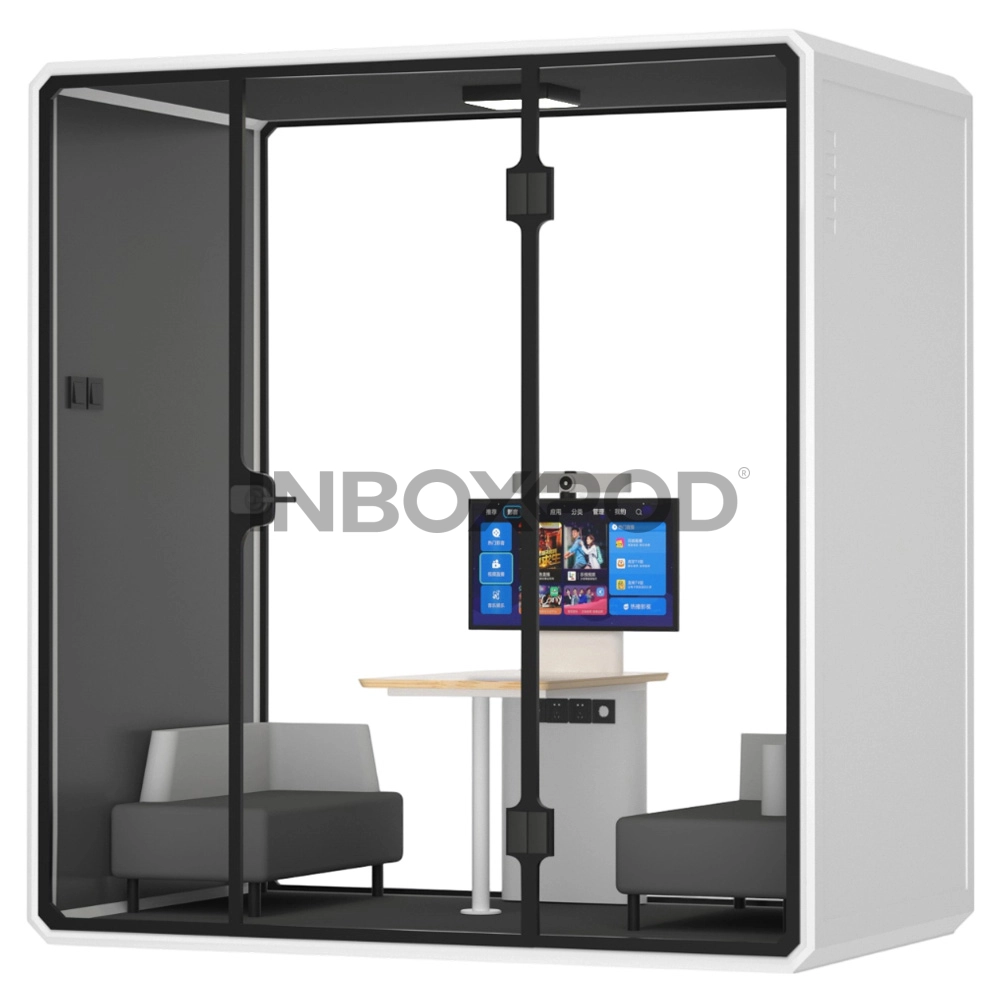
Silence Booth/Office Pod Prefabricated V series-L size
Designed for team collaboration and small meetings, the L-size booth provides a comfortable and acoustically optimized space for 4–6 people. With premium sound insulation, efficient ventilation, and integrated lighting and power systems, it ensures focus, privacy, and productivity—even in the busiest open offices.
Whatsapp: +8613535292957