
Acoustic Testing and Certification for Phone Booths
- Why acoustic performance matters in modern workspaces
- Psychological and productivity impacts
- Typical user expectations for an office phone booth
- Common pain points I encounter
- Standards and test methods for phone booths
- Key international standards and metrics
- Laboratory vs. in-situ testing
- What each metric tells you and target values for booths
- Interpreting test results and achieving certification
- Reading a laboratory report
- Common failure modes and remedies
- Certification pathways and labels
- Practical guidance: selecting, specifying, and validating an office phone booth
- Specification checklist I use with clients
- Comparing products: a simple standards comparison table
- On-site validation steps I always perform
- Working with manufacturers: what to ask and how INBOXpod approaches testing
- Questions to ask any vendor
- How I evaluate claims from manufacturers
- INBOXpod: performance, testing and global support
- Case studies and measurable outcomes
- Example: improving privacy in a 200-desk open-plan office
- Example: healthcare environment with confidentiality needs
- Performance verification: what success looks like
- FAQ — Acoustic Testing and Certification for Phone Booths
- 1. What is the difference between STC and Rw?
- 2. How loud should ventilation be inside a phone booth?
- 3. Can a phone booth be made entirely soundproof?
- 4. Should I accept manufacturer test reports without an accredited lab?
- 5. How do I balance acoustic performance with ventilation, power and ergonomics?
- 6. What documentation should be delivered with a completed installation?
- Contact and next steps
I have spent more than a decade working with architects, facilities managers, and manufacturers on acoustic solutions for modern workplaces. In this article I explain, from first principles and practical experience, how acoustic testing and certification for office phone booths should be planned, executed and interpreted. I cover the most widely accepted standards and metrics (Rw/STC, STI, RT60, and A-weighted sound reduction), practical test methods, how to read laboratory reports, and how certification helps procurement teams choose products that deliver privacy and speech clarity in open-plan offices, education and healthcare settings.
Why acoustic performance matters in modern workspaces
Psychological and productivity impacts
Acoustic privacy is not a luxury. Research shows noise and speech distraction in open-plan environments reduce concentration and increase error rates. The World Health Organization has issued guidance on environmental noise impacts on health and well-being (see WHO Environmental Noise Guidelines WHO, 2018).
Typical user expectations for an office phone booth
Users expect an office phone booth to provide private conversations without shouting, clear two-way speech on calls, and a low intrusion to adjacent workstations. These expectations translate into measurable acoustic targets: a minimum sound reduction (Rw/STC) that lowers transmitted speech levels, and good internal reverberation control (RT60) to keep voices intelligible on calls.
Common pain points I encounter
Clients often tell me about booths that look solid but fail in privacy tests, booths that produce a trapped bass resonance, or solutions that compromise ventilation for the sake of sound isolation. I’ll show how objective testing prevents these outcomes.
Standards and test methods for phone booths
Key international standards and metrics
There is no single phone booth standard, but several international standards apply to sound insulation and room acoustics. Important references include:
- ISO 717-1:2013 — Rating of sound insulation in buildings and of building elements (airborne sound insulation, Rw). See ISO 717 (Wikipedia).
- ASTM E90 / ASTM E413 — Laboratory measurement and rating of airborne sound transmission loss and STC (Sound Transmission Class). Details: ASTM E90.
- ISO 3382 / ASTM E336 — Room acoustic parameters including reverberation time (RT60) used to assess speech clarity inside small enclosures. See RT60 (Wikipedia).
- Speech Transmission Index (STI) and Speech Intelligibility Index (SII) — metrics for speech clarity, often used for assessing internal booth performance. See STI (Wikipedia).
Laboratory vs. in-situ testing
Laboratory (ISO/ASTM) tests are done in controlled transmission suites to produce repeatable, comparable Rw/STC numbers. In-situ tests (on-site) simulate real use and capture installation effects such as gaps, floor coupling, and adjacent finishes. I recommend both: lab tests to verify product capability and on-site tests to verify installation.
What each metric tells you and target values for booths
Practical target ranges I use when specifying office phone booths:
- Rw / STC: 30–40 dB — Basic speech privacy (lower voices masked but loud speech may transmit). 40+ dB — strong privacy for confidential calls.
- STI: 0.45–0.6 — adequate for phone calls with some processing; 0.6+ — very good speech clarity for conferencing.
- RT60 inside booth: 0.25–0.5 s (depending on booth volume) — lower RT60 reduces echoes and improves perceived clarity.
Interpreting test results and achieving certification
Reading a laboratory report
A proper lab report should include the test method (e.g., ASTM E90 or ISO 10140 series), frequency-by-frequency transmission loss, single-number rating (Rw or STC), and test room description. Look for a calibrated reference microphone, measurement uncertainty, and a clear description of the mounting condition. If the report lacks these items, request clarification or a retest.
Common failure modes and remedies
Booths often fail to meet targets due to:
- Flanking paths — gaps around the base, poor door seals, or building penetrations. Remedy: continuous seals, floor isolation, and careful sealing of HVAC and cable penetrations.
- Insufficient mass or panel construction — thin panels transmit low frequencies. Remedy: increase panel mass, add constrained-layer damping or tuned absorbers.
- Internal reverberation — hard internal surfaces that cause echo on calls. Remedy: add broadband absorbers, tuned bass traps, or soft finishes.
Certification pathways and labels
Third-party certification provides buyers with confidence. Look for test reports from accredited labs (e.g., ISO/IEC 17025 accredited). Certifications to request or verify include:
- Independent laboratory test reports for airborne sound insulation (ASTM/ISO standards).
- Acoustic performance verification for speech clarity (STI measurements) and internal RT60.
- Product safety and emissions certifications for integrated equipment (e.g., electrical compliance CE/UL) when the booth contains electronics.
Practical guidance: selecting, specifying, and validating an office phone booth
Specification checklist I use with clients
When specifying an office phone booth, include:
- Target Rw/STC value (lab and in-situ).
- Internal RT60 and desired STI/SII for speech clarity.
- Ventilation (ACH) and HVAC noise limit in dB(A) so ventilation doesn’t compromise privacy.
- Power, network, and cable penetration details with sealing strategy.
- Required third-party test reports and acceptable accrediting bodies.
Comparing products: a simple standards comparison table
| Metric / Standard | Purpose | Target range for office phone booth | Typical test method |
|---|---|---|---|
| Rw / STC | Airborne sound insulation (privacy) | 30–45 dB (40+ for confidential calls) | ISO 717-1 / ASTM E90 + E413 |
| RT60 | Internal reverberation (speech clarity) | 0.25–0.5 s (varies with volume) | ISO 3382 / ASTM E336 |
| STI / SII | Quantifies speech intelligibility | 0.45–0.7 (higher is better) | IEC 60268-16 based measurements |
| Background noise (A-weighted) | Noise floor for calls and privacy | <35 dB(A) inside booth recommended | ISO 1996 / ISO 9613 measurement methods |
Sources: ISO standards overview (see ISO), ASTM standards (see ASTM), and speech intelligibility references (see STI (Wikipedia)).
On-site validation steps I always perform
After installation I conduct or require:
- In-situ airborne insulation testing to confirm installed Rw/STC.
- Background noise measurement inside booth with typical ventilation running (dB(A)).
- Speech clarity tests or informal user trials to confirm subjective satisfaction.
Working with manufacturers: what to ask and how INBOXpod approaches testing
Questions to ask any vendor
Request the following before procurement:
- Lab test reports with accreditation details (ISO/IEC 17025).
- Information on door seals, floor isolation, and HVAC penetrations.
- Internal finish and absorption data (NRC or absorption coefficients).
- Warranty, service, and installation scope that covers acoustic performance.
How I evaluate claims from manufacturers
Marketing claims without lab evidence are insufficient. I verify the test scope (lab vs in-situ), mounting conditions, and whether accessories (e.g., ventilation units) were present during testing. I also prefer vendors who provide both objective test data and user-case performance data from end customers.
INBOXpod: performance, testing and global support
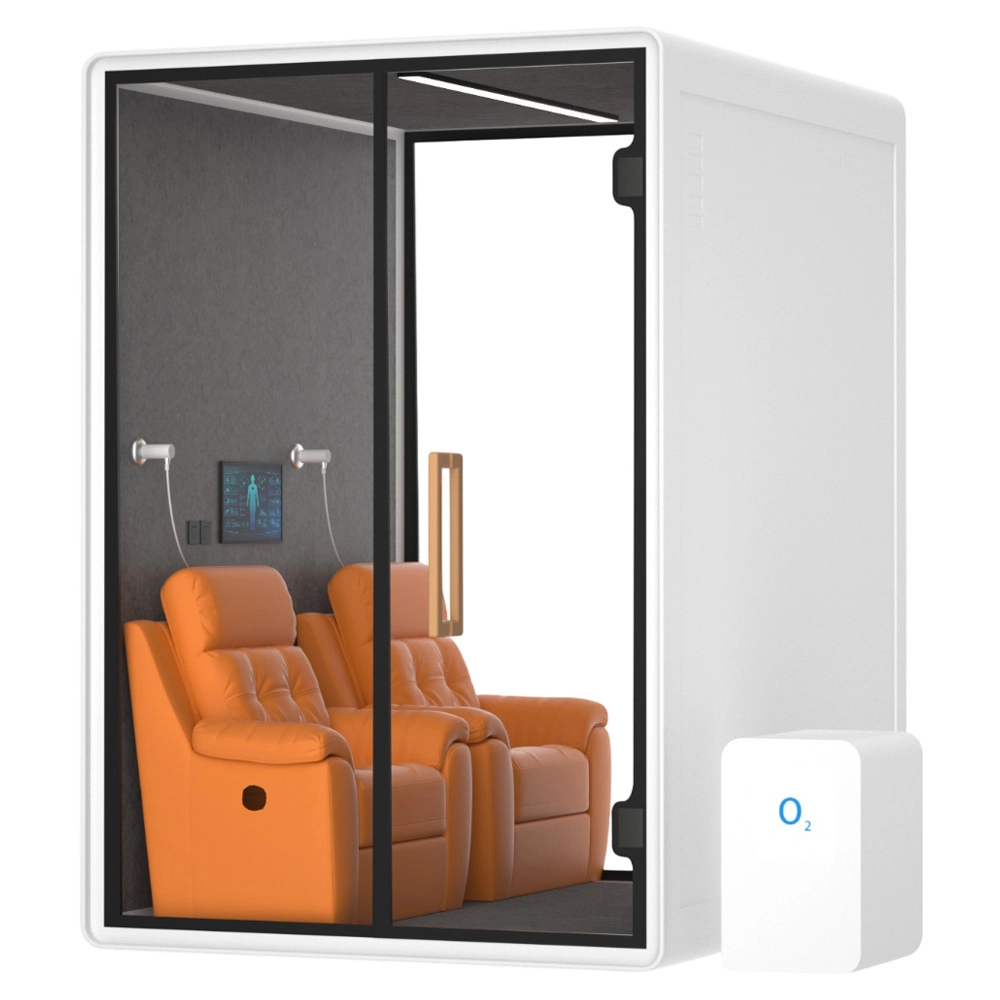
INBOXpod, a pioneering brand of Guangdong Province INBOXPOD Company Limited, designs and manufactures modular acoustic pods that blend advanced acoustic engineering with sustainable materials and precision manufacturing. With over a decade of industry expertise, we deliver high-performance, fully soundproof solutions engineered for clarity, privacy, and durability. Our pods are versatile by design—adaptable for open-plan offices, education spaces, healthcare environments, retail and commercial settings, and wellness or study areas—so organizations can create focused, comfortable micro-environments without costly construction. Trusted by clients in more than 60 countries across North America, Europe and the Asia–Pacific region, INBOXpod combines a strong global distribution network with localized support to meet diverse market needs.
We provide end-to-end OEM and ODM services, helping partners and brands take custom concepts from brief to market-ready product, whether for bespoke finishes, specialized acoustic performance, or integrated technology. Guided by a mission to enhance productivity and well-being and a vision to lead globally in soundproof solutions, INBOXpod is committed to continuous innovation, sustainability, and long-term partnerships that deliver measurable value and exceptional user experience. Our main product lines include soundproof office pod, oxygen pods, and soundproof study pod. Learn more at INBOXpod or contact us at sale@inboxpod.com.
Case studies and measurable outcomes
Example: improving privacy in a 200-desk open-plan office
In one project I led, the client required phone booths that achieved at least 40 dB Rw and internal background noise below 34 dB(A). We specified pods with double-skin panels, high-performance seals, and a decoupled floor plinth. Laboratory tests showed Rw = 42 dB; in-situ testing after installation showed 39–41 dB depending on positioning and adjacent partitions. Staff surveys after deployment reported a 60% drop in reported speech distractions.
Example: healthcare environment with confidentiality needs
For a healthcare clinic we combined an Rw target of 45 dB with STI verification for teleconsultations. The pods included dedicated ventilation with attenuators to keep HVAC noise under 30 dB(A). Independent verification showed the solution met both sound insulation and speech clarity targets, allowing confidential consultations in multi-use spaces.
Performance verification: what success looks like
Success is a combination of measured compliance and end-user satisfaction: Rw/STC values within target range, RT60 low enough for clean audio, STI scores indicating intelligibility, and staff confirming perceived privacy. Objective lab and in-situ evidence plus post-occupancy feedback complete the validation loop.
FAQ — Acoustic Testing and Certification for Phone Booths
1. What is the difference between STC and Rw?
STC (Sound Transmission Class) is an American single-number rating based on ASTM methods; Rw (weighted sound reduction index) is an ISO single-number rating. They both summarize airborne sound insulation but are derived using slightly different standards and weighting curves. For practical procurement either can be used if test method and conditions are specified. See STC (Wikipedia).
2. How loud should ventilation be inside a phone booth?
I recommend keeping background noise inside the booth below 35 dB(A) for comfortable phone calls. For high-fidelity conferencing, targets closer to 30 dB(A) are preferable. Ensure ventilation units are specified with appropriate flow and low noise ratings and include attenuation where necessary.
3. Can a phone booth be made entirely soundproof?
“Entirely soundproof” is impractical, but a well-designed booth can achieve very high levels of privacy (Rw/STC 45+ dB) for typical speech frequencies. Low-frequency sounds and structure-borne vibration are the most challenging to eliminate and require mass, damping, and isolation design measures.
4. Should I accept manufacturer test reports without an accredited lab?
No. Always prefer test reports from accredited labs (ISO/IEC 17025). If a manufacturer’s internal tests are used, request a witnessed test or third-party verification to ensure repeatability and transparency.
5. How do I balance acoustic performance with ventilation, power and ergonomics?
Design is a systems exercise. Integrate acoustics, ventilation, and services from the start. Use low-noise ventilation with attenuators, plan sealed service entries, and specify interior finishes that provide absorption without compromising isolation. I routinely produce integrated spec sheets that balance these requirements.
6. What documentation should be delivered with a completed installation?
Request: (1) lab test reports with accreditation, (2) in-situ test results, (3) as-built drawings showing penetrations and seals, (4) ventilation noise data, and (5) warranty and maintenance instructions.
Contact and next steps
If you are specifying or procuring office phone booth solutions and need help defining acoustic targets, reviewing test reports, or arranging independent testing, I can help advise on practical performance targets and validation steps. For product inquiries or to see INBOXpod’s certified solutions (soundproof office pod, oxygen pods, soundproof study pod), visit INBOXpod or email sale@inboxpod.com. We provide OEM/ODM services and can deliver tailored acoustic performance verified by accredited labs to meet your privacy and clarity requirements.
ROI Analysis: Adding an INBOXpod to Your Wellness Center
Silence Booth V‑Series M Size — Prefabricated Soundproof Office Pod
Maintenance, Warranty & Lifecycle Costs of Soundproof Pods
Acoustic Performance Metrics Procurement Teams Need
Home-demo
How long does it take to assemble an INBOXpod booth?
Most of our booths can be assembled without tools in about 30 minutes, making installation quick and hassle-free.
What materials are used in the construction of the booths?
Our booths are made from sustainable, high-quality materials including aluminum alloy frames and acoustic panels designed for optimal soundproofing.
What is the typical sound insulation level of your acoustic booths?
Our booths typically achieve up to 27 dB noise reduction, meeting Class B sound insulation standards suitable for offices and study environments.
Do you provide after-sales support and warranty?
Yes, we provide comprehensive after-sales service and warranty to ensure long-term satisfaction with our products.
Can the booths be customized to fit specific space requirements?
Yes, we offer flexible customization options including size, color, and additional features to perfectly suit your needs.
Silence Booth/Office Pod Prefabricated V series-L size
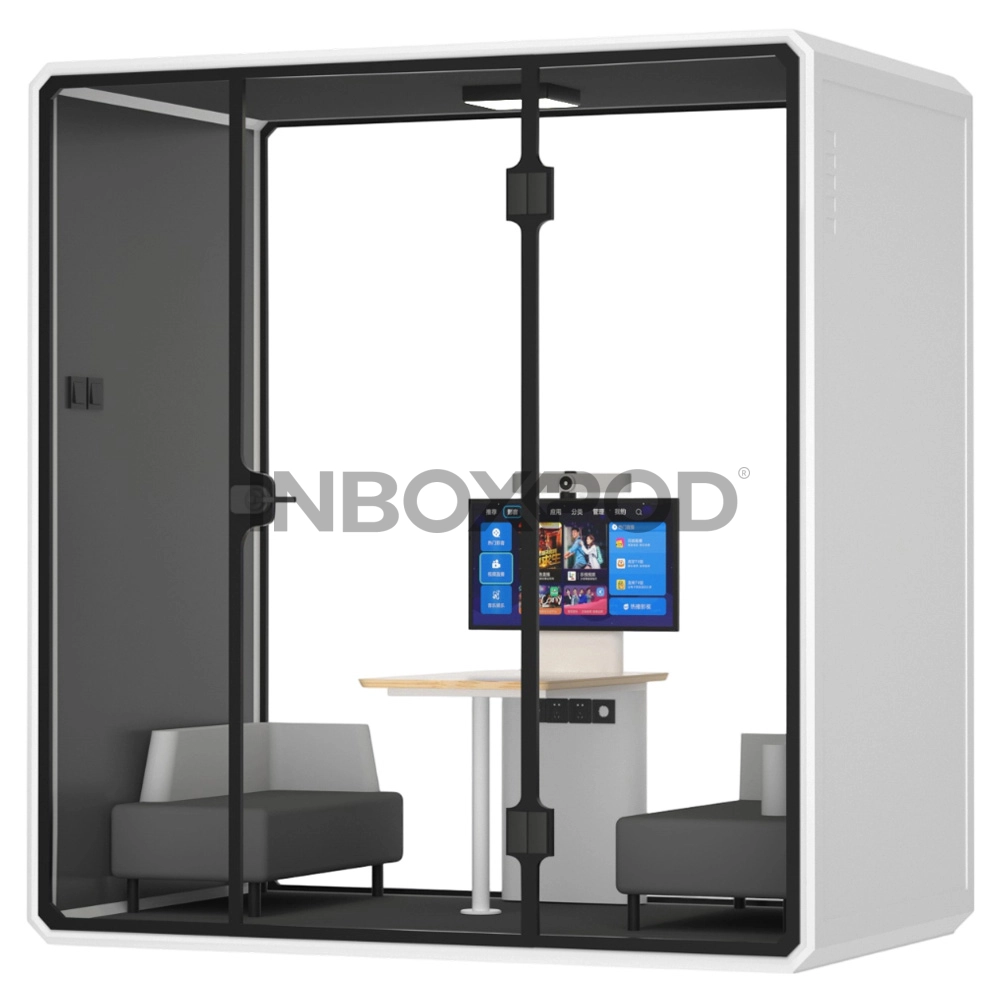
Designed for team collaboration and small meetings, the L-size booth provides a comfortable and acoustically optimized space for 4–6 people. With premium sound insulation, efficient ventilation, and integrated lighting and power systems, it ensures focus, privacy, and productivity—even in the busiest open offices.
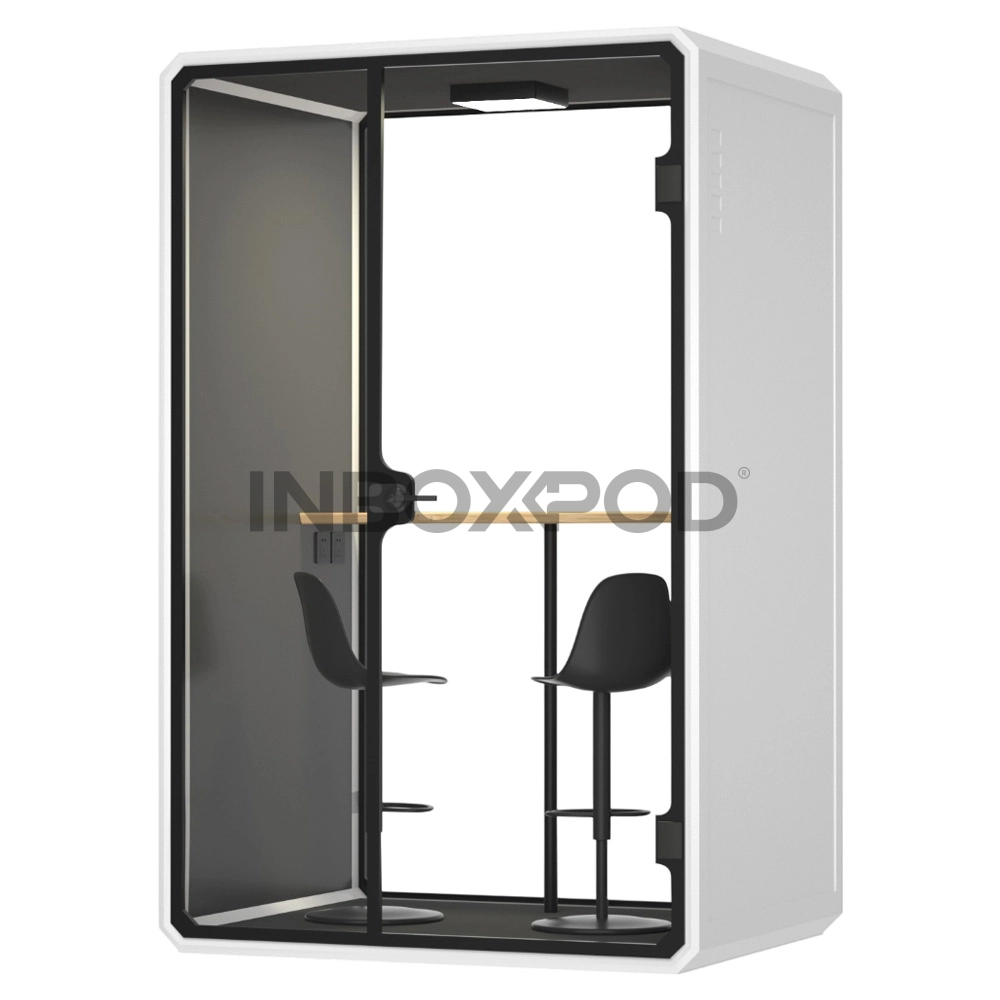
Silence Booth/Office pod Prefabricated V series - M size
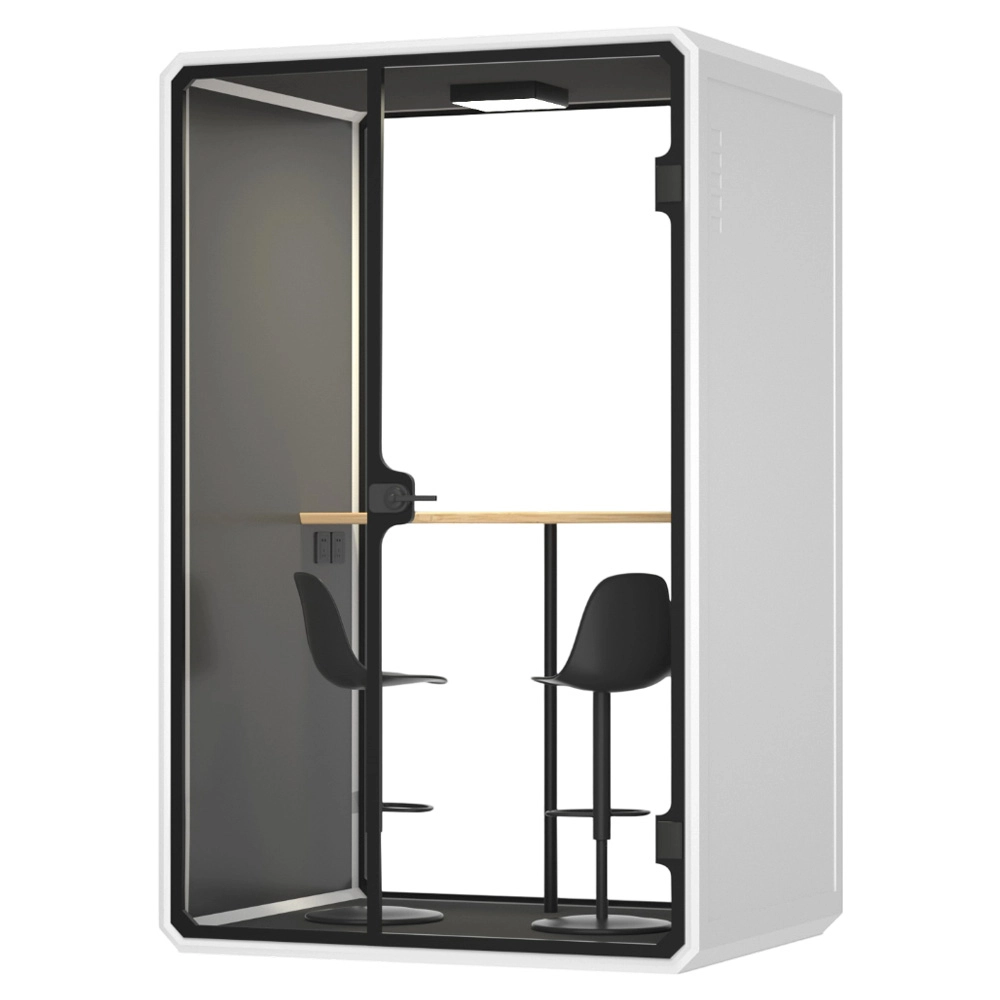
Ideal for two-person discussions or focused solo work, the M-size booth offers a balanced mix of privacy and flexibility. Its advanced acoustic panels reduce external noise effectively, while the smart ventilation and lighting systems create a comfortable, quiet environment for calls, meetings, or concentrated tasks.
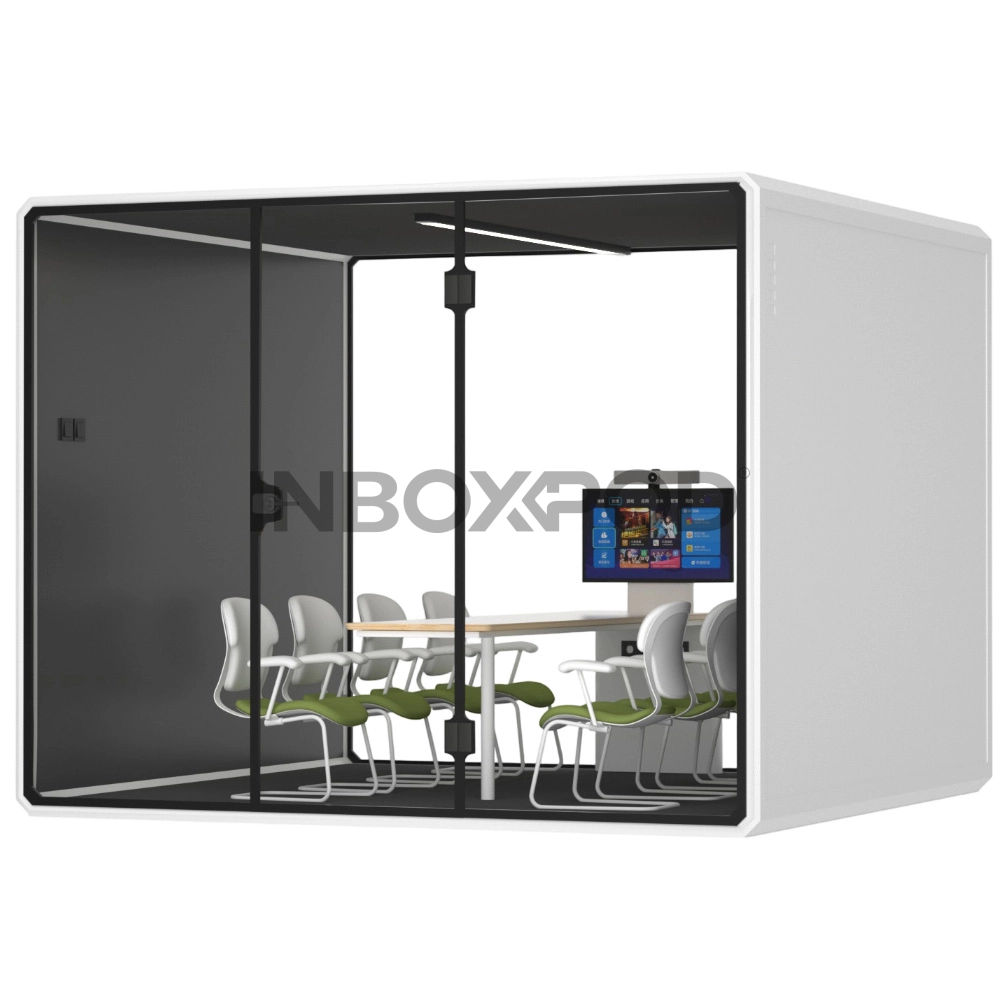
Silence Booth/Office pod Prefabricated V series-XXL size
The XXL-size booth is a premium modular acoustic room designed for larger teams and dynamic discussions. With ample interior space for 6–10 people, it provides exceptional sound insulation, effective air circulation, and integrated lighting to ensure comfort during long meetings. Ideal for boardroom sessions, client presentations, and collaborative brainstorming, the XXL booth creates a quiet and productive environment within any workspace.
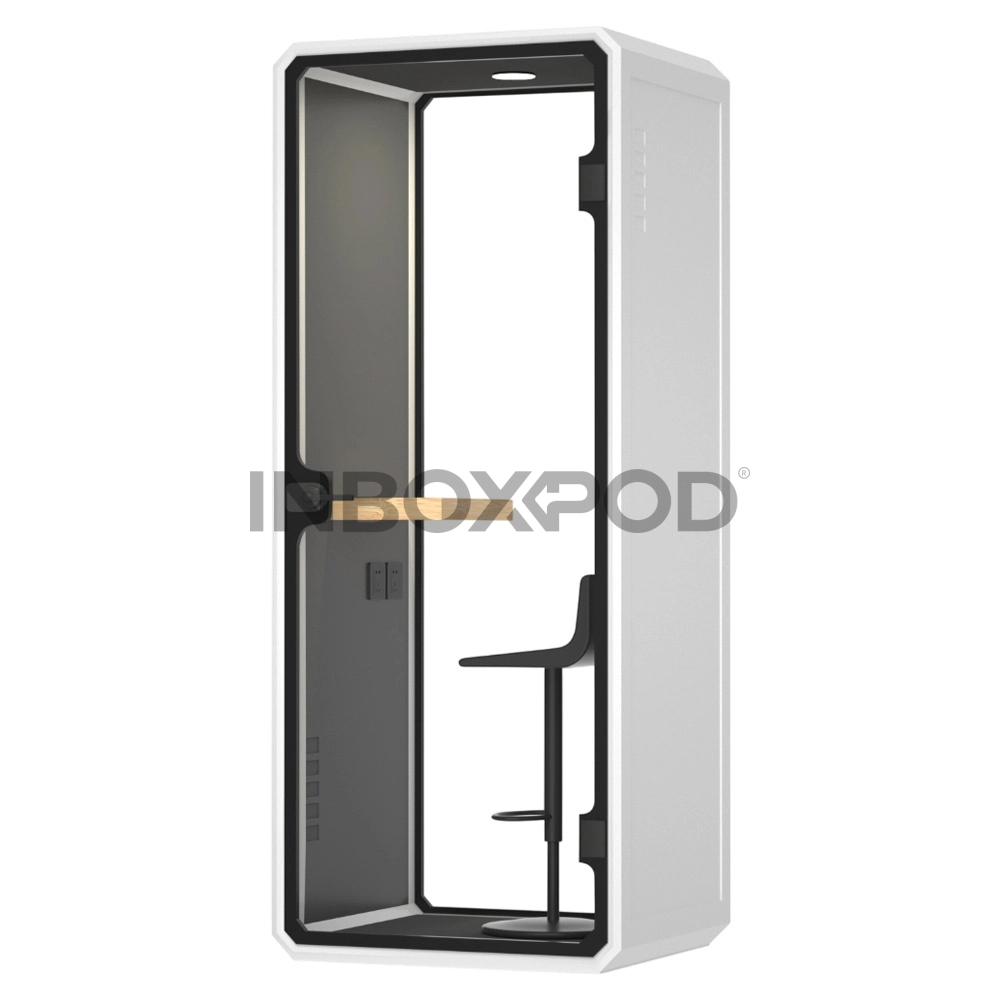
Silence Booth/Office pod Prefabricated V series-S size
Built with high-performance acoustic materials and a modular prefabricated structure, it offers excellent sound insulation, fast installation, and efficient space utilization.
Whatsapp: +8613535292957